Einstein’s Spacetime Trampoline – The Day Gravity Became Geometry
From Falling Elevators to Mercury’s Dance – How Einstein Rewrote the Rules of Reality
Introduction: From Newton to Einstein – A New Way to See Gravity
In Chapter 1, we explored how Newton’s apple-inspired insights unified the heavens and Earth under a single law of gravity. But Newton’s theory, as powerful as it was, couldn’t explain everything. Mercury’s orbit defied his predictions, and the deeper nature of gravity remained a mystery.
Enter Albert Einstein, who in 1907 reimagined gravity not as a force but as the curvature of spacetime itself. This chapter dives into Einstein’s thought experiments, his groundbreaking equivalence principle, and how his ideas solved mysteries that Newton couldn’t.
Einstein’s Elevator Epiphany: When Gravity Became Indistinguishable from Acceleration
Einstein’s journey toward reimagining gravity began with a simple yet profound observation: What if gravity feels like acceleration?
The Falling Painter Thought Experiment
Imagine a painter falling from a rooftop, clutching a brush. As both painter and brush plummet toward the ground, Einstein realized something extraordinary:
"If the painter lets go of the brush, it will float beside him as if weightless. To the painter, it would seem as though there were no gravity at all.”
This realization led to what Einstein called the equivalence principle —the idea that the effects of gravity are indistinguishable from those of acceleration.
The Elevator Thought Experiment
To make this concept more concrete, Einstein devised his famous elevator thought experiment:
-
Scenario 1: Stationary Elevator on Earth Imagine you’re inside an elevator on Earth. Drop a ball—it falls to the floor at an acceleration of 9.8 m/s² due to gravity.
-
Scenario 2: Accelerating Elevator in Deep Space Now imagine the same elevator accelerating upward in deep space at 9.8 m/s², with no gravitational field present. Drop the ball—it behaves exactly as it did on Earth, falling to the floor at 9.8 m/s² relative to you.
Einstein concluded that no experiment conducted inside the elevator could distinguish between these two scenarios. This equivalence between gravitational and inertial mass became the cornerstone of his theory of general relativity.
Modern Validation: The Luxor Hotel Experiment (2024)
Fast forward over a century to Las Vegas, where researchers tested Einstein’s equivalence principle in a unique setting—the inclined elevators (known as "inclinators") of the Luxor Hotel pyramid. These elevators travel at a 39-degree angle rather than vertically, providing an opportunity to study motion under unconventional conditions.
The Research Question
The experiment sought to answer: “Can an inclined elevator’s motion be measured from inside without any external reference?” This question extended Einstein’s original thought experiment by introducing an inclined motion vector.
Methodology
- Setup: Researchers rented rooms at the Luxor Hotel to access its inclined elevators.
- Equipment: Pendulums, gyroscopes, and motion sensors were used to measure acceleration and inclination angles inside the elevator while isolating external visual cues (e.g., windows or outside references).
- Data Collection: The team analyzed how objects behaved when dropped inside the elevator and decomposed their motion vectors to determine whether internal observations could reveal inclination.
Findings
The experiment confirmed that even in an inclined elevator traveling at an angle, internal measurements could accurately determine acceleration and inclination without external references—validating Einstein’s equivalence principle in this unique scenario.
Spacetime: The Fabric You’re Warping Right Now
Einstein proposed that mass and energy curve spacetime—a fusion of three spatial dimensions and one temporal dimension into a dynamic grid. Objects move along geodesics (the straightest possible paths) in this curved spacetime.
The Trampoline Analogy – And Why It’s Flawed
The classic “bowling ball on a trampoline” analogy helps visualize curvature but has limitations:
- Missing Dimensions: The trampoline is 2D and bends into a third dimension; spacetime curves within its own 4D structure without needing higher dimensions.
- No Absolute “Down”: Unlike the trampoline analogy, spacetime has no preferred direction—curvature is symmetrical around massive objects like stars or planets.
Your Invisible Dent in Spacetime
Even you warp spacetime! A 70 kg human creates curvature of ~10⁻³⁹ meters—undetectable but real. Earth’s curvature, however, is far deeper. This curvature isn’t just abstract math—it has real-world consequences, like ensuring your GPS doesn’t misguide you by 11 kilometers every day.
Why Earth’s Spacetime Dent Affects Your GPS
Einstein’s equations predict two relativistic effects acting on GPS satellites orbiting 20,200 km above Earth:
- General Relativity (Time Speeds Up): Satellites experience weaker gravity at their altitude, causing their clocks to tick 45 microseconds/day faster than Earth clocks.
- Special Relativity (Time Slows Down): Satellites move at 14,000 km/h, causing their clocks to tick 7 microseconds/day slower than Earth clocks.
The net effect? Satellite clocks gain 38 microseconds/day (45 − 7).
How 38 Microseconds = 11 Kilometers
The speed of light (c) is 300,000 km/s. Even tiny timing errors scale catastrophically: Error = Time difference X c = 38 X 10 ^ (-6) s X 300,000 km/s = 11.4 km/day
Without corrections:
- Your GPS would misplace you by ~0.5 km every hour.
- Within a week, errors would exceed 77 km—rendering navigation useless.
Mercury’s Mystery Solved: Spacetime’s First Victory
Recall from Chapter 1 how Newton’s gravity failed to explain Mercury’s orbital precession—a shift of 43 arcseconds per century that defied prediction. Einstein’s equations fixed this by treating spacetime as dynamic geometry rather than static space:
- Newton’s Blunder: He blamed an unseen planet, Vulcan.
- Einstein’s Fix: The Sun’s mass curves nearby spacetime, altering Mercury’s path precisely as observed.
- Proof in Motion: Europe’s BepiColombo probe (launched in 2018) measures relativistic effects in Mercury’s orbit with atomic-clock precision.
Mercury’s dance proved spacetime isn’t static—it responds dynamically to mass and energy, laying the groundwork for modern astrophysics.
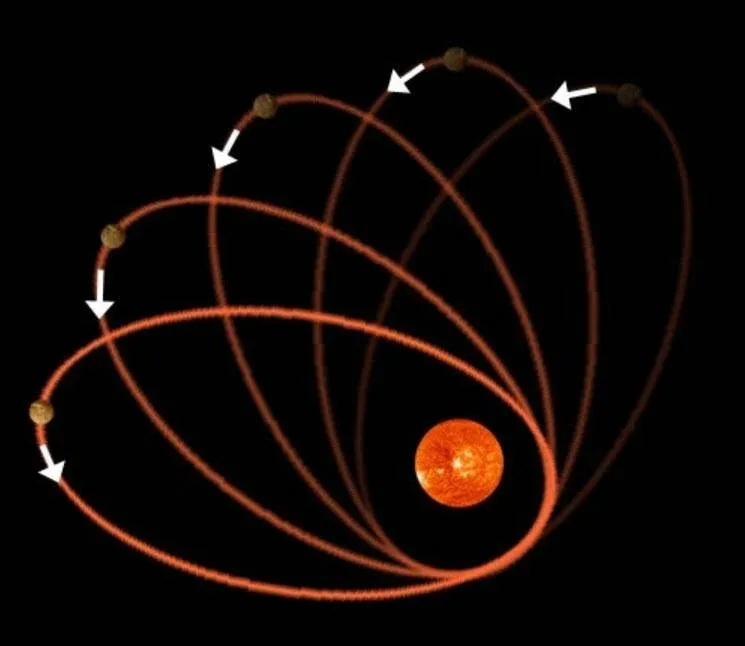 Mercury’s dance proved spacetime isn’t static—it responds dynamically to mass and energy, laying the groundwork for modern astrophysics.
FAQs: Untangling Spacetime Mysteries
- “If spacetime is curved, why don’t I feel it?” You do—as weight! Earth’s surface pushes you upward against spacetime’s downward curve. In free fall (like astronauts aboard the ISS), you follow spacetime's curve directly and feel weightless because there is no opposing force.
- “How can light bend if it has no mass?” Light follows geodesics—the straightest possible paths—in curved spacetime. Near massive objects like stars or black holes, these geodesics are distorted, causing light to bend—a phenomenon first confirmed during the 1919 solar eclipse.
- “Does Einstein’s equivalence principle apply everywhere?” Yes, but with limitations. The principle holds locally (in small regions where tidal forces are negligible). In larger regions with significant variations in gravitational fields (e.g., near black holes), additional relativistic effects must be considered.
Einstein's Unfinished Symphony: When Quantum Mechanics Crashes the Party
While general relativity explains gravity on large scales beautifully, it falters at quantum scales—such as near black hole singularities or during the Big Bang:
- Relativity predicts infinite density at singularities, but quantum physics forbids infinities.
- Loop Quantum Gravity suggests spacetime is granular at the Planck scale (10⁻³⁵ m), preventing singularities altogether.
Testing quantum gravity experimentally remains one of physics’ greatest challenges due to gravity's extreme weakness compared to other forces.
Conclusion: From Thought Experiments to Cosmic Law
Einstein transformed our understanding of gravity by showing it was not a force but a manifestation of curved spacetime—a profound insight validated by experiments like Mercury's orbit and modern tests such as those conducted at the Luxor Hotel.
As we continue exploring gravity through experiments and observations, we uncover new layers of complexity that challenge our understanding of reality itself—a journey that began with Einstein's imagination and continues today with cutting-edge research.
Next Chapter Teaser:
Gravitational Waves – How We “Heard” Two Black Holes Collide And Why It Changed Everything.